Tuesday, August 26, 2008

Preaching the Word at St. John's Lutheran Church in Atlanta


America's favorite Lutheran pastor, Bradley Schmeling, preaches on Luke 4:1-13, the temptation of Jesus in the wilderness. This is classic Schmeling breathing life into Law and Gospel drawing from both the Old and New Testaments. His conclusion: "'The body broken for you' means that we are now bread broken for the world."

The Church of Corinth...in Atlanta

I recently came across a year-old post that compared my congregation, St. John's Lutheran Church in Atlanta to the Church in Corinth. I'll let you reach the post for yourself at The Church of Corinth Lives... in St. John's Lutheran Church in Atlanta, but the thrust of Johnny Helm's article was to compare the tolerance of sexual immorality in the Corinthian church (1Cor 5) to St. John's celebration of our gay pastor, Rev. Bradley Schmeling.

At the time, the committee on appeal's had summarily removed Pastor Schmeling from the ELCA roster of ordained minister's while the Churchwide Assembly was moving to exhort bishops not to prosecute pastors such as Schmeling and to commission the committee on human sexuality to draft proposals for changing ELCA to allow gay ministers to live in committed, chaste same-sex unions. In other word, the ELCA seems to be reaching an historic tipping point toward the full inclusion of homosexuals both in the pew and the pulpit.

Like many well-meaning Christians, Mr. Helm's sees this as a dangerous and immoral move within the Church. I do believe he goes too far when he claims that St. John's, indeed the whole ELCA denomination, is now an apostate church because of the way we "treat the Ten Commandments, the Biblical condemnation of particular lifestyles (adultery, sorcery, homosexuality, etc.), and the entire Word of God."

I accept that there are reasonable biblical arguments on both sides of this issue. So I welcome Johnny Helm's candor to voice his comparison of St. John's to the biblical church of Corinth. I want to extend the comparison and see if we can avoid quarrelsome division. Here is my response.


Johnny,

I want to thank you for taking the time to write about my congregation and our pastor. I especially appreciate your effort to think through this biblically. To be sure, we disagree on whether the kind of homosexuality that the Bible speaks against bears any relation to the committed and monogamous relationship that Pastor Brad and Darin actually have.

For example, while scripture condemns certain sexual relations between men and women, it does not follow that God condemns all forms of heterosexuality (1Cor 7:1-2; 8:36). To the contrary, Paul recommends marriage as a hedge against the temptation of sexual immorality. In like manner, the condemnation of certain same-sex relations does not condemn all forms of homosexuality. Chaste same-sex marriage may well be the best hedge against the temptations of same-sex promiscuity. Regardless of orientation, it may be "better to marry than to burn" (1Cor 7:9). You probably don't buy what I'm saying, but let's move on to other ways St. John's is like the Corinthian Church.

Like the church in Corinth, St. John's is a Spirit- and grace-filled church (1Cor 1:4-7). God is present in our worship services, and people are open to the Word and Wisdom of God (1Cor 2:14-16). We are a Bible-believing and Christ-confessing church (1Cor 15:1-4). In fact, our Church Council recently voted that we would become a "Book of Faith" congregation. This is a program within the ELCA to renew engagement and commitment to the Bible.

We are a congregation that that seeks the highest gifts of prophecy and love (1Cor 14:1). As a congregation, our prophetic voice speaks God's grace to those who have felt rejected by the Church and we speak against the misunderstand of though who unintentionally place limits and exclusions on grace, whether that be through racism, sexism or heterosexism. Instead, we shun quarrelsome division (1Cor 1:10-15).

As a congregation we practice hospitality and unconditional love. We are a community centered around the Lord's supper (1Cor 11:17-34). We follow Paul's admonition, "when you come together to eat, wait for one another" (v. 33). We do not serve straights first and gays last. We do not give loaves to the rich and crumbs to the poor. All are welcome. All share in the same food and the same drink.

Are we perfect? No, and the church of Corinth was flawed as well. But we do place ourselves in God's hands that we might be conformed to his will. As good Lutherans, we hold together both Law and Gospel. We trust the Holy Spirit and scripture to lead us into truth and holiness. We know that God treasures us and that we hold God's treasure within our earthen vessels (2Cor 4:7). We are a new creation in Christ, and we have been given the ministry of reconciliation (2Cor 5:17-19). This is what was great about the church in Corinth, and may it be said of St. John's as well.

The biblical test is to judge the tree by its fruit. As you surely know, the early Jewish Christians had major problems with Gentile Christians who were not getting circumcised as Scripture so clearly commands. What settled the question was not simply a biblical debate, but the Apostles in Jerusalem recognized that the Holy Spirit had been poured out on uncircumcised gentiles (Acts 15:1-29, see also Acts 11:1-18). It was this recognition of the work of the Holy Spirit that gave Paul such courage to speak on behalf of the Gentile churches and not to make salvation by grace dependent on act circumcision and other acts of the flesh. Paul encouraged the Corinthian to remain as uncircumcised as they were when God had called them (1Cor 7:17-20). Indeed this was "the life the Lord had assigned" them. Gay Christians generally believe that their orientation is as God assigned it to them, and God calls them as they are. Bedrock Lutheranism maintains that salvation is only by grace through faith, no preconditions.

At St. John's we sing this little song.
Welcome, my full welcome,
all my children come to me.
I will make a way for you,
I will make you holy.
God alone is holy, and God alone draws us into his holiness. "Circumcision is nothing, and uncircumcision is nothing; but obeying the commandments of God is everything." (1Cor 7:19). In this spirit, we wish to say that being straight is nothing, and not being straight is nothing. And we wish to say it with the fellowship we share.

Again I don't expect that you'll buy everything I say here. But I want you to know that we can both take the Bible seriously and disagree. I hope that someday you'll be able to recognize the work of the Holy Spirit in congregations like St. John's. In any case, hold us gently in your prayers.

May God's peace be with you.

Friday, August 22, 2008

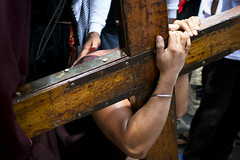
Burdens and Crosses

Here is an outline of a participatory Bible study for youth.

Notes: Scripture passages are quoted at length to give background. You need not quote the whole passage but focus in on the text in bold. Texts in italics are meant to be paraphrased verbally to the group.

Lift high the heavy Cross

Invite one youth to carry big cross to center. Use a large cross made of two logs, about as much as I can carry by myself, 60+ pounds.

Is this too much for you to carry? Do you need any help?

Now have the whole group lift the cross.

Lift it high. Be aware of how this feels.

Now while the cross is lifted is a good time to pray for blessing our Bible study or the Lord’s Prayer. Set the Cross down carefully.

Is this cross heavy our light? What’s the difference?

Is it easy to be a disciple or hard?

A Contradiction? “My burden is light” versus “Carry the cross”

Words of Comfort

Matthew 11:28-30 28 "Come to me, all you that are weary and are carrying heavy burdens, and I will give you rest. 29 Take my yoke upon you, and learn from me; for I am gentle and humble in heart, and you will find rest for your souls. 30 For my yoke is easy, and my burden is light."


Words of Challenge

Matthew 10:34-40 34 "Do not think that I have come to bring peace to the earth; I have not come to bring peace, but a sword. 35 For I have come to set a man against his father, and a daughter against her mother, and a daughter-in-law against her mother-in-law; 36 and one's foes will be members of one's own household. 37 Whoever loves father or mother more than me is not worthy of me; and whoever loves son or daughter more than me is not worthy of me; 38 and whoever does not take up the cross and follow me is not worthy of me. 39 Those who find their life will lose it, and those who lose their life for my sake will find it. 40 "Whoever welcomes you welcomes me, and whoever welcomes me welcomes the one who sent me.

Matthew 16:24-25 24 Then Jesus told his disciples, "If any want to become my followers, let them deny themselves and take up their cross and follow me. 25 For those who want to save their life will lose it, and those who lose their life for my sake will find it.

How can we resolve this paradox? Is following Jesus easy or heavy?

Not even Jesus could carry his own cross

A stranger is pressed to carry his cross. Who is this?

Matthew 27:31-32 31 After mocking him, they stripped him of the robe and put his own clothes on him. Then they led him away to crucify him. 32 As they went out, they came upon a man from Cyrene named Simon; they compelled this man to carry his cross.

He can’t save himself from the cross.

Matthew 27:39-43 39 Those who passed by derided him, shaking their heads 40 and saying, "You who would destroy the temple and build it in three days, save yourself! If you are the Son of God, come down from the cross." 41 In the same way the chief priests also, along with the scribes and elders, were mocking him, saying, 42 "He saved others; he cannot save himself. He is the King of Israel; let him come down from the cross now, and we will believe in him. 43 He trusts in God; let God deliver him now, if he wants to; for he said, 'I am God's Son.'"

If Jesus can’t carry his own cross or free himself from it, how can he save us?

Letting go of our own burden and bearing each other’s burden

Hebrews 12:1-4 Therefore, since we are surrounded by so great a cloud of witnesses, let us also lay aside every weight and the sin that clings so closely, and let us run with perseverance the race that is set before us, 2 looking to Jesus the pioneer and perfecter of our faith, who for the sake of the joy that was set before him endured the cross, disregarding its shame, and has taken his seat at the right hand of the throne of God. 3 Consider him who endured such hostility against himself from sinners, so that you may not grow weary or lose heart. 4 In your struggle against sin you have not yet resisted to the point of shedding your blood.

Galatians 6:1-3 My friends, if anyone is detected in a transgression, you who have received the Spirit should restore such a one in a spirit of gentleness. Take care that you yourselves are not tempted. 2 Bear one another's burdens, and in this way you will fulfill the law of Christ. 3 For if those who are nothing think they are something, they deceive themselves.

What’s the difference between a burden and the cross Jesus calls us to carry? Or is it all the same?

What are our burdens? What weighs us down?

Conclusion

1 Peter 5:7 7 Cast all your anxiety on him, because he cares for you.

Take this time as an opportunity to let go of burdens.

This week, find someone you can confide in. Support one another.

Invite all to pray around the cross. You may lift the cross as a group again, perhaps halfway up so that faces are not blocked by arms and the Cross.

Image by DeejayMarlon, the Philippines

Thursday, August 21, 2008

Confession and Forgiveness at Christ’s Table

Here is another piece of personal, sacramental theology for my Intersections class at Columbia Theological Seminary. It's "confessional" in three ways: it's a personal account, it's about confession of sin, and it relates to the Lutheran confessions.

At St. John’s Lutheran Church we celebrate Christ’s Table every Sunday morning. Renewal of Lutheran worship within the ELCA has lead to weekly communion in many congregations whereas this sacrament had fallen into infrequent use. After the sacraments of Baptism and Holy Communion, Lutherans have recognized Private Confession and Absolution as a third sacramental means of grace. Several weeks ago I had my first experience with this ritual. In this paper I wish to explore how private confession before pastor can open a way to the sacrament of the table. First I will describe what prompted me to this and what I experienced in the ritual itself. Then I will consider on how this connects with the worship practices at St. John’s and draw out some theological implications.

Pastor Bradley Schmeling has been mentoring me in my preparation for ministry for about two years. I hit a crisis about a year ago when I took my psychological exam for entrance to candidacy. During the interview, I was questioned on many moral issues and felt compelled to reveal several painful areas of sin and shame in my life. This was an odd mixture of “psychology” and “confession”. Dr. Snook did not presume to be a pastor, and yet the Synod had in effect authorized him to take my confession and transmit it back to the church in the language of psychopathology. This left me with a great deal of confusion. Had I confessed sin in need of God’s continued grace or did I have psychological problems that needed to be “therapeutically resolved.” Pastor and I have met for a year to sort this out. I’ve also worked with a psychologist for half a year to clarify issues the viewpoint of psychology. My sin I had long confessed not only to myself and God, but to pastor, wife, therapist and several other trusted persons. I believed that God had forgiven me all along and had given me grace not to continue in these sins, but the stain or stigma had somehow remained. At length Pastor asked me if I felt absolved of this sin, whether I had truly heard words of absolution spoken to me. I wasn’t sure what this meant. I had confessed. I had been forgiven. I had changed my ways. I had even gotten some therapy. What more could I do? Pastor proposed that in the following day we would meet in the sanctuary and go through a ritual of confession and absolution. I was willing to give it a try.

We met the next day in the sanctuary. We placed two chairs facing each other by the altar within the rails. I took a worship book out from a pew, and Pastor had his. Before we began, Pastor quipped that, while it’s still in the worship book, nobody ever really uses it. He also said somewhat cryptically that this was not so much about a sin which I had committed, but about something which had happened to me. The order is for Individual Confession and Forgiveness is brief.[1] The pastor begins an invocation with the sign of a the cross and speaks an invitation, “You are free to confess before me, a pastor of the church of Christ, sins of which you are aware and which trouble you.” The penitent then prays a prayer of confession. I confessed my sin in two categories. The first was with regard to the sin that had so shamed me, and the second was the category of spiritual pride which I had come to see as the cause of continued trouble. My prayer concluded as printed in the order, “I ask for strength to turn from sin and to serve you in newness of life.” Pastor comforted me by reading Psalm 103. The order then moved to absolution. Pastor stood to lay both hands on my head to speak words of forgiveness as words which come from God. These are more than words of assurance; they are priestly words. “James, in obedience to the command of our Lord Jesus Christ, I forgive you all your sins in the name to f the Father, and of the Son, and of the Holy Spirit.” I sat in dark silence. My silence was not for lack of words. Rather the Spirit allowed me to see quite clearly how the words that might appear in my mind were reflexive or defensive words of self-justification and that in silence I could allow them to pass unsaid. I was in a place of suspense where I was somehow separated from my normal sense of self and severed in particular from my spiritual pride. “As far as the east is from the west, so far he removes our transgressions from us.”[2] We shared a greeting of peace, and he left me to remain as I wished.

How then does this relate to communion? Significant to the Lutheran tradition, the same space, the sanctuary, is used for both individual confession and communion. Individual confession is both private and public. The words shared are private, not within the hearing of anyone but the penitent and pastor, but they are shared in a public worship space. Such intimate speaking and hearing are not possible in communion liturgy. Our worship services begin with confession and forgiveness at the baptismal font, and this is good preparation for communion later in the service. But there are some inadequacies. It is possible to be simply “one of the crowd”, making a secret confession in the heart—or no confession at all—and hearing a general pardon spoken to all. This can lead to habitual or weak-hearted confession and desensitize the ears to hearing pardon. One can be reminded of being a sinner, feel sorry or inadequate and try to do better next time, but miss the whole point that it is power of the Holy Spirit that actual sanctifies us. In individual confession, the laying on of hands signals this powerfully. Where one is seriously troubled by sin whether for guilt of it or for shame of it, confession and forgiveness in worship may not suffice to open the grace to be received in communion. At St. John’s, each communicant is given the bread and wine individually and told, “This…is for you.” Likewise in private absolution one hears the words, “Your sins are forgiven you.” In either case, it is hearing for oneself that matters.

In the Lutheran tradition, private confession is not compulsory.[3] Rather one is free to seek out the grace to be found in it, the grace set free from sin. Being coerced to confess, in whatever context, leads to shame. Being free to confess with assurance of God’s absolution can lead out of both shame and guilt. We live in a culture where people make all sorts of confessions, but far too often these are confessions without the grace of absolution. Therapists have become our confessors, while our churches make too little use of Christ’s priestly gift. Jesus breathes upon us and says, “Receive the Holy Spirit. If you forgive the sins of any, they are forgiven them; if you retain the sins of any, they are retained.”[4]

A Post-Script

Since writing this paper, I have voiced an ethics complaint against the psychologist who tested me. He was not living up to his professional responsibility to give primacy to my wellbeing as a therapeutic client. He exploited my emotional vulnerability in a way that has left me damaged for over a year and a half. As a friend of mine put it, “the psych eval shouldn't be a ‘test’ to ‘trip you up’ but rather an everyday—and caring—opportunity to look at one's gifts and challenges.” Perhaps it was this abuse that made it so hard to experience a freeing sense of forgiveness apart from using the ritual of confession and absolution. Perhaps this is what made the sin sticky.

Sin is not just a problem of what we do to others, but also of what is done to us. We are all entangled in the same web of sin. Can we extend the idea and practice of absolution to include separation from sin however it entangles us? We need forgiven, but we also need to be set free from the shame of what has been done to, around and among us. God is merciful to both the abuser and the abused.


[1] Evangelical Lutheran Church in America, Evangelical Lutheran Worship, Augsburg Fortress, 2006, pp. 243-244.

[2] Psalm 103:12.

[3] P. H. D. Lang, “Private Confession and Absolution in the Lutheran Church: A Doctrinal, Historical, and Critical Study.” Concordia Theological Quarterly, October 1992, 56(4), p. 248.

[4] John 20:22-23.

Wednesday, August 20, 2008

Moments of Baptism

Here is a bit of personal, sacramental theology. It was a writing assignment for a course called Intersections at Columbia Theological Seminary.

How does my baptism matter? My initial response as one who grew up in the Pentecostal tradition is to ask, which one—baptism in water or baptism in the Spirit? In the context of this class, the question seems to be simply about water baptism, the one baptism which can be observed in a single ritual at a particular point in time. The distinctive belief—and practice—of Pentecostals is that the baptized believer should also seek the baptism in the Holy Spirit as if they were potentially distinct moments in time. This contention has spurred no little doctrinal dispute. The difficulty, it seems, is with how we situate baptism in time: one discrete event, a sequence of events, a continuous process, an eternal moment apart from time, etc. I will not attempt to resolve this here, but I will work from my own experience within which there have been several distinct markers. To speak of water baptism in isolation from spirit baptism would do injustice to the integral work of the Holy Spirit within my life.

Perhaps the most significant fact of my water baptism is that I chose to be baptized. From the age of four to seven, I had responded to several altar calls to confess my sins and accept Jesus as my personal Lord and Savior. This meant I was saved. I can’t recall what sins I needed to confess at that age, but I certainly did not want to go to hell or be left behind in the rapture because of them. Accepting Jesus Christ into my heart was supposed to be sufficient for salvation, but induced fear and guilt would lead this little child to doubt whether I was saved. My response to this insecurity was to respond to altar calls several times.

I grew up with baptismal services where new believers—whether children or adults—would be immersed in water. At the age of seven I asked if I could be baptized. Children did not usually get baptized that young; nine or ten was a more suitable age. But because I was insistent about this my parents and pastor agreed. That summer I was baptized in a creek. This creek flowed around the backside of the church property and then came around the property of some prominent church members a small distance from the church. We had the service and picnic on their property. It had better visibility and was a great place for all of us to swim afterward. Being baptized in a creek connected more strongly in my mind to the gospel story of Jesus’ own baptism in the Jordan than did the use of a baptismal tank or worse yet baptism by “sprinkling” which this tradition did not recognize. This public profession of faith with affirmation of the congregation helped solidify the commitment I had made in previous altar calls. I never again felt the need to respond to an altar call to get saved—I was now a baptized believer. I felt more mature and serious about living my faith and being a useful vessel for God.

Baptism, however, did not assuage my fear of the rapture or guilt over sin. I grew up with the idea that, if I failed to confess a sin, the Lord might return and I’d be left behind to face the tribulation and quite possibly without my family. Learning to seek forgiveness quickly was the point, but it left me with much dread and rapture attacks. For example if my family we to disappear inexplicitly, then I might panic that they had been taken up and I left behind.

I think the greater significance of my water baptism is that set the stage for receiving the baptism of the Holy Spirit. A year I was baptize in the Spirit with the evidence of speaking in tongues, as taught in the Assemblies of God. The Sunday evening service would typically end with invitation to come forward prayer. Some would seek healing or some other touch of the Holy Spirit. I was taught to tarry in the Spirit as Jesus had instructed the disciples to “tarry in Jerusalem” for the gift of the Spirit. I was always one of the last to leave this time of earnest prayer. All around me I would hear people praying in tongues, singing, shouting, weeping or laughing however the Spirit may lead them. Tarrying in the Spirit was a way opening oneself to the anointing of the Holy Spirit. Specifically the baptism of Holy Spirit is the decisive opening of the soul such that the charismatic gifts might begin to flow in one’s life. While I chose to be baptized in water, the Holy Spirit decided when to give me this second baptism.

These two baptisms are part of larger work of the Holy Spirit in my life, a process which has no end-point. Now when I contemplate the baptism of Jesus, I see myself. The prophet John raises Jesus from the water; the Spirit descends to anoint him; and finally, a voice from heaven cries out, “This is my son, my beloved.” My whole life I knew that God loved me and that I was child of God, but only much later in life did I truly experience this third, unexpected baptism. I heard this same voice say to me, “You are my child, my beloved; in you I am well pleased.” However saved or gifted I may have been matters less and less. Each baptism bears the seeds of the next, and the latter outshines the former.

I am not sure what to make of these three moments of baptism. I do not know where they lead. Theologically, we may bundle all three into one sacrament of baptism, but it can take much longer to unpack each promise. Even Jesus had to be driven into the wilderness to test what had been given to him. Transfiguration is brighter than baptism, and resurrection is yet more transparent than transfiguration.

Wednesday, August 13, 2008

Creation

Lord, I am your creation, I will trust your creation.
You breathe in all creation, so I will breathe in you.
Your creation is life, and I will live in your creation.

Tuesday, July 15, 2008

The Sower and God's Ecology

The Gospel reading this Sunday was the familiar parable of the sower of seed (Matthew 13:1-9). Perhaps this parable is too familiar and we don't hear it with new ears. We think we understand it because Jesus gives us his own interpretation (verses 18-23). We'd like to think we're the ones with a heart that is like the good soil. We might envision that we could work a little more on the hard soil, the rocky spots and weedy patches, as if we were the gardeners of our own lives. We are uneasy about the barren spots in our lives.

This time around reading the parable of the four soils, I find myself more puzzled by the indiscriminant sowing of the sower. What farmer would throw away good seed in places that are not prepared for it? Would not a good farmer first break up the compacted soil, remove excess rocks, and pull up the weeds? You are right to point to God's initiative here because soil is completely passive. It cannot make of itself "good soil". Perhaps the path was worn by Roman soldiers advancing on Jerusalem. What can the soil do? What is redemptive here for those who have been trampled under foot, or for the rocky soil or the weedy soil? Why doesn't the good farmer tend the soil before mocking it with seed that will not come to fruition?

Perhaps God has a higher wisdom for these difficult patches. Perhaps the sower uses the compacted paths to enter the field without crushing the tender plants he wishes to grow. Perhaps compacted soil and stones are part of building up a "highway for the Lord." Perhaps the rocks line canals and ditches for the flow of water into the fields. Or the rocks could serve as a wall or terrace to protect and uplift the good soil. Perhaps the weeds are rehabilitating lifeless soil or retaining moisture and reducing soil erosion. All these conditions are part of God's ecology.

This winter St. John's needed to repave our parking lot. For years weeds and water had been making steady progress breaking up the asphalt. As much as we might try to preserve our parking lot, nature breaks it down. If we left it completely alone, the natural environment would utterly reclaim it. But for now, St. John's has a beautiful new parking lot.

We might not like all the terrain in our lives, but it is all part of God's ecology, God's new creation.

Blessings, James

Monday, June 2, 2008

Shavuot , the Law & Pentecost

How is the giving of the Torah on Mount Sinai related to the Christian story of Pentecost? To some of us, this may sound like a stretch. After all, the Apostle Paul often pits the written Law of Moses against the life of the Spirit. For example, Romans 7:6 reads, “But now we are discharged from the law, dead to that which held us captive, so that we are slaves not under the old written code but in the new life of the Spirit.” Christians often associate the Law with sin, death, bondage, and condemnation, and breathe a sigh of relief that we don’t have to follow all those old rules any more (as if we ever would have in the first place). I no longer share this dim view of the law; rather I’ve come to see Torah as God’s life giving instruction to all of humanity. God speaks now even to us from Mount Sinai. God said to Moses, “Have them make for me a sanctuary, so that I may dwell among the people.” (Exodus 25:8) The Lord touches down to the head of Mount Sinai so that He might descend further to live within, among and through us. He does not want a sanctuary so that he can dwell in it, a shrine or temple. No God longs to dwell in us, all humankind dwelling on this earth.

So what is the connection between the giving of the Law and Pentecost? Lately, I’ve been listening to Jewish audio on www.chabad.org. A particular talk of Shavuot by Rabbi Moshe New made the connection for me. [http://www.chabad.org/library/article_cdo/aid/519868/jewish/Moses-King-David-And-The-Baal-Shem-Tov.htm] What is Shavuot you might ask? It is the Jewish festival that falls seven weeks and one day after Passover. This is the Festival of Weeks, the lifting of the First Fruits of the wheat harvest.

And for the Church, it is the day of Pentecost, the fiftieth day after Passover. Unfortunately the Jewish and Christian calendars are out of sync this year. By Christian tradition, Easter is the Resurrection of Christ, the Pascal Lamb, on the Sunday after Passover. This year Easter was March 23, 2008, four weeks before Passover began for the Jews on the evening of April 19, 2008. Consequently, Pentecost and Shavuot fall four week apart this year, May 11 and June 7. Christians and Jews ought to celebrate Shavuot and Pentecost on the same day, and I pray that some day this is so.

Let’s get back to the connection, even if we’re not on the same calendar. Rabbi New traces connections between Shavuot and three Jewish figures: Moses, David, and the Baal Shem Tov, the first leader of Hassidic Judaism. The connection is subtle; the Bible does not make the explicit connection between Shavuot and the Festival of the Giving of the Torah. However, these are usually the same day, the sixth of Sivan, give or take a day on some years. So now we see a link between the First Fruits and Torah. Jews elevate the first sheaves of wheat to God even as God bestows from above the life giving words of Torah. The Law is not given to condemn the Jews. Quite the opposite, God enters into an everlasting covenant with Israel; the nation gives herself even as a bride to God as the bridegroom. Rabbi New also points out that Shavuot is the only festival where a sacrificial sin offering is not to be made. The marriage covenant is pure.

Now what else happened no the sixth of Sivan, the day Torah was given? Moses turned three months old. This is the day when his mother placed him in the river so that he might be rescued from Pharaoh’s slaughter of Jewish boys. Moses crossed the water in safety to be made the son of Pharaoh’s daughter and his own mother was called to nurse him. Later Moses would lead the Israelites to safety through the water, and God would draw his son Israel like a child out of Egypt. Moses carries Israel to the foot of Mount Sinai, where God descends in thunder and lightning, smoke and fire, shaking the mountain in a dense cloud. On Mount Sinai heaven touched down to earth and gave to Moses all the words of Torah. Later God’s glorious presence would fill the tabernacle, the Tent of Meeting. Now the living presence that had so frightened the people on Sinai was dwelling in the midst of the camp.

The next connection Rabbi New makes with David. King David passed away on 6 Sivan. David was the first true king of Israel; Saul had fallen short. David forged a Kingdom and made preparations for the building of the Temple. While on Sinai the holiness of God had reached down to people, now under King David the holiness of the people was lift to Jerusalem.

Finally, Rabbi New points out the leader of the Hassidic movement had also passed away on Shavuot. I am to ignorant to say much about the Baal Shem Tov, meaning Master of the Good Name. You can listen to Moshe New’s own account of the significance Baal Shem Tov. New does explain that Hassidic teach somehow brings together the holiness from above with godliness from the ground upward. The true dwelling place of God is in the heart of the Hassid, the faith one.

Let’s turn now to the Christian story in Acts 2. For Christians, Pentecost is known as the birth of the Church, the day when the Holy Spirit descended with tongues of fire on the 120 disciples gathered in the upper room. The believers started to speak in new languages they had not known. The Holy Spirit gave them the words. This was the fulfillment of the prophecy of Joel that the Spirit would be poured out upon all flesh. (Joel 2:28-32)

Joel 2:28-32 28 Then afterward I will pour out my spirit on all flesh; your sons and your daughters shall prophesy, your old men shall dream dreams, and your young men shall see visions. 29 Even on the male and female slaves, in those days, I will pour out my spirit. 30 I will show portents in the heavens and on the earth, blood and fire and columns of smoke. 31 The sun shall be turned to darkness, and the moon to blood, before the great and terrible day of the LORD comes. 32 Then everyone who calls on the name of the LORD shall be saved; for in Mount Zion and in Jerusalem there shall be those who escape, as the LORD has said, and among the survivors shall be those whom the LORD calls.

In Pentecost we see the Law of the Spirit impressed upon the heart of the Church. Indeed the gift of the Holy Spirit, the abiding presence of God, is given to every believer in Christ through baptism. We are baptized in both water and spirit. We emerge from the water even as Jesus did in his own baptism to look up. The heavens are torn open and the Spirit descends upon us as fire from above. A new word is formed in our mouths, and we hear a new voice speak with in us, saying, “You are my child, my beloved.”

The full Torah, the full counsel, wisdom, and knowledge of God, flows through the Holy Spirit, for “the Spirit knows the will of the Father.” According to Jewish tradition Moses received the full Torah, both the revealed written Torah and the hidden oral Torah, on Mount. Jesus taught both what is revealed and what is hidden; moreover, he announced to his disciples that all that is hidden will be made known. Jesus told them to pray to the Father for gift of the Holy Spirit. “How much more will the heavenly Father give the Holy Spirit to those who ask him!” (Luke 11:13b) Joshua asked Moses to stop two elders from prophesying. “But Moses said to him, ‘Are you jealous for my sake? Would that all the LORD's people were prophets, and that the LORD would put his spirit on them!’" (Numbers 11:29) Is the Law at odds with the Spirit? Not at all, the giving of Torah on Mount Sinai is the promise of the Holy Spirit to all God’s people. God has been pouring out his Spirit all along.

Blessings for Shavuot, June 8, 2008. Take time hear the Ten Commandments with new ears.

Monday, December 17, 2007

advent

the hovelled spirit longs to be free--to be beautiful
and you, how you hover long to free us
your forever gaze fills us and we are beautiful--you are beautiful
holiness is your welcome
holiness, your embrace
holiness is all that ever set us free
come! beget in us the risen one
beget in us--eternity--your son
amen

Thursday, December 6, 2007

I am sending you

My journey began in Galilee. Jesus sent the twelve disciples on a mission, out on their own.[1] After they returned, Jesus began to disclose to his disciples how the Son of Man must be betrayed into human hands to suffer, die and rise on the third day.[2] How could this make any sense? The Son of Man was supposed to come in clouds of glory with great power to judge the nations.[3] The crowds were told “The kingdom of God is at hand!”[4] but we were told that this coming one would be crushed.

I wracked my head trying to remember all he was teaching us from the time we headed up to Jerusalem until we reached the outskirt of David’s City. Jesus seemed to know that entering Jerusalem would be the death of him. In fact, he held back, saying, “No prophet could be killed outside of Jerusalem.”[5] Before we entered the City, he tried a few more times to tell how the Son of Man would suffer.[6] It still did not make any sense to us. Perhaps we didn’t want it to make sense. It seemed he had been preparing us all along for the days ahead, not just the hour of his death, but even more the years that followed his ascension. He told us days would come when we would long to see one of the days of the Son of Man.[7] Indeed there have been many of those days! But this takes me back to the beginning. What was he trying to teach along the way? What was it he wanted us to see?

The twelve seemed to think they had some special status over the rest of us. After all, they were the apostles. They even argued with one another.[8] On one occasion, Jesus drew a little child close to him and said, “Do you see this child standing next to me? Whoever welcomes this child in my name welcomes me.”[9] (For some reason that line stood out for me, and many years later it came back to me in a song.) They seemed to treat us like the little children, but we were disciples of this great prophet all the same. Didn’t we too have a prophet’s call? We were always standing next to Jesus. In fact, some of us supported Jesus and the twelve out of our own resources, and some of us were the first to see his empty tomb. [10] Sure it wasn’t official until Peter came on the scene,[11] but we were there—we were there all along.

At any rate, Jesus looked at that one little child and said, “The least one of us is great in God’s own eye.” A few of our mothers remembered that even before he was born, no less than the Prophet John the Baptist was said to be great in the sight of the Lord.[12] Sometimes only a parent can see these things. We knew this one was to be a great prophet too. Jesus seemed to say, “Whoever listens to you—a child—listens to me.”[13] It had nothing to do with status or authority as the world reckons it. Just as some had welcomed Jesus as a great prophet,[14] anyone who would welcome this child in his name welcomes even Jesus, the Son of Man. And whoever welcomes the Son of Man also welcomes the one who sends him. Of course the opposite is also true, there are many who reject both us and the Son of Man!

I don’t think the twelve ever really got it.[15] That child was already a great one in the reign of prophets, the kingdom of God, no less than John the Baptist—if only by virtue of standing next to Jesus as an object lesson.[16] Wasn’t Jesus himself like a child when he stood by the Baptist? [17] He only had to ask for John’s baptism for the heavens to open up. Jesus made it so simple. He said that it was the Father’s good pleasure to give us the kingdom, and that the heavenly Father knew how to give the good gift of the Holy Spirit to those who ask.[18] So we do not give up praying, even when the heavens seem to be shut up and no showers of justice appear on the horizon. Even a poor widow could badger a little justice out of corrupt judge.[19] This is how Jesus taught us to pray and how he prayed so often alone at night or with a few disciples near by. Both prayer and the Holy Spirit were learned on the road.

I recall one time not long after the twelve came back from their first mission.[20] Jesus wanted to meet privately with them. They went off to a secluded place in the desert, but the crowds found them out and poured in by the thousands. They twelve had learned much about hospitality having lived from village to village on their mission with only the welcome of a few as their means of sustenance. When they saw the multitudes who had gathered around them at this remote location, they knew that there would not be enough food to go around. They were overwhelmed with ministry and now with the demand of hospitality. They took this to Jesus, but he put it right back to them saying that they give the crowds food to eat. They had cast out demons and healed the sick, but were nowhere prepared to feed so many. The twelve were humbled by the five thousand. Jesus made up for the lack, but how would they get along without him? Even dividing the crowd into groups of fifty each, how could twelve disciples serve some one hundred groups? Just picking up the broken pieces was well more that twelve baskets could handle.

And there was another broken piece. After the crowds had dispersed, Jesus returned to his original intention which was to meet privately with the disciples.[21] He needed to disclose to them what he saw in the road ahead. With only the disciples nearby, he shares something about his destiny, something about who he is, something that the crowds and not even the disciples were prepared to grasp. To the crowds Jesus was like John the Baptist, Elijah, or some ancient prophet who had stirred the people. To the twelve he was coming into view as the Messiah and so were twelve seats of power. But Jesus reveals only that “The Son of Man must undergo great suffering, and be rejected by the elders, chief priests and scribes, and be killed, and on the third day be raised.”[22] (Luke 9:22).

Before entering Jerusalem, his disciples could not fully grasp what the suffering of the Son of Man would mean either for Jesus or for the disciples themselves. Their eyes were opened to the resurrection only after he had arisen. But there were even greater trials for the disciples after his ascension. Jesus had to prepare them for this from the beginning.[23] He would say to them, “If any wish to be my followers, let them deny themselves and take up their cross daily and follow me.”[24]

Just as bread was to be blessed, broken and set before the multitudes, it was time for Jesus to bless and break, and send out more disciples. So it was eight days later that Jesus took Peter, James and John up the mountain to pray.[25] While the three disciples were captivated by the dazzling display of light about Jesus and the appearance of Moses and Elijah in glory, Moses and Elijah spoke to Jesus about his departure which he was about to accomplish in Jerusalem. The brilliance of the Transfiguration seemed to conceal the darkness of the cross, but even this darkness swallowed up the disciples for a moment and terrified them.

Jesus comprehended the darkness of the cross. He knew the distance and span of his life was short, even so he set his face to go to Jerusalem where he would eat his last Passover meal. He appointed seventy more disciples to go as he has sent the twelve.[26] He sent them by pairs that they would ahead of him to places he himself had once intended to go. He sent them like day laborers into fields that were too many and too ready for harvest for what little time he had left.[27]

“See, I am sending you out like lambs in the midst of wolves.”[28] He sent us in full vulnerability. This was our share in the suffering of the Son of Man. We would be welcome in one town and hated in another. The Son of Man was to be rejected and so were we.

“Carry no purse, no bag, no sandals.”[29] He sent the disciples like day laborers into the fields. We worked and ate what was set before us. We would cure the sick, cast out demons and announce that the kingdom of God has come near.

Despite the dangers and hardships we always found places of welcome. Upon entering a house we would say, “Peace be upon this house.”[30] We looked for those whom we called “children of peace.”[31] They were the ones who welcomed us and received the peace we had to share. Jesus taught us to seek this peace first, even before healing, preaching or eating. We came as a delegation offering terms of peace.[32] Wherever we found a child of peace, a true lamb in the midst of wolves, we knew that the entire kingdom was coming into view.

We returned with joy, and Jesus said, “I watched Satan fall from heaven like a flash of lightning. See I have given you authority to tread on snakes and scorpions, and over all the power of the enemy; nothing will hurt you. Rejoice that your names are written in heaven. Blessed are the eyes that see what you see!”[33]

Taking all this in, I wondered what the coming of the Son of Man looks like. And it came to me not only in a flash, but also measure by measure, line upon line, some hidden and some so visible that one does not see it. It came to me as a song.


Like Lambs among the Wolves [Midi]


Do you see this child standing next to me?
Whoever welcomes this child in my name welcomes me too

The least of you is great in God’s own eye
Whoever listens to you—a child—listens to me—and

I am sending you, yes I am sending you
Like lambs among the wolves I am sending you

Do not pack a bag or an extra pair of shoes
The children of peace will welcome you

The Son of man will come, the Son of Man will come
The Son of man will come on that day—See

I am sending you, yes I am sending you
Like lambs among the wolves I am sending you


[1] Lk 9:1-6
[2] Lk 9:21-22
[3] Dn 7: 13-14, Lk 21:26-28; 9:26; 11:29-32; 12:8-9; 17:22-25,27-37; 18:7-8
[4] Lk 4:43; 8:1
[5] Lk 13:33
[6] Lk 17:25; 18:31-34
[7] Lk 17:22
[8] Lk 9:46; 22:24-26
[9] Lk 9:46-48
[10] Lk 8:1-3; 24:1-11
[11] Compare Lk 8:11 with verses 12, 33-34
[12] Lk 1:15
[13] Lk 10:16, I’m inserting “child” here on basis of 9:48.
[14] Prophecies of Simeon and Anna regarding Jesus and Zechariah regarding John demonstrate the welcoming of a prophet in childhood, Lk 2:25-38; 1:66,76.
[15] They had to re-learn the lesson at the last supper! Lk 22:23-27
[16] Lk 7:28. Prophetic gesture is often as powerful as any spoken word.
[17] Lk 3:21-22. Also early Christian art often portrays Jesus with the stature of a boy at the time of his baptism, while John is portrayed at a full adult.
[18] Lk 11:13; 12:32
[19] Lk 18:1-8
[20] Lk 9:10-17
[21] Lk 9:10 original purpose with resumption in vv. 18-27.
[22] Lk 9:22. Also I prefer to read vv. 18-22 as an uninterrupted passage. For Luke and Mark 8:29, Peter’s confession transitions directly to Jesus Son of Man disclosure. Only Matthew 16:16-21 inserts so much pro-Peter content as to disconnect the story. Mark 8:32-33 actually points out how Peter embarrasses himself by rebuking Jesus for his disclosure.
[23] Luke suggests that the disciples only come to understand Jesus’ Son of Man disclosure after the resurrection, 24:6-8, 25-27, 44-46. The disciples were prepared for this post-resurrection moment so that would be “witness of these things.” (v. 47-49)
[24] Lk 9:23, 14:21
[25] Lk 9:28-36
[26] Lk 10:1-20
[27] Lk 10:1-2
[28] Lk 10:3
[29] Lk 10: 4
[30] Lk 10:5-6
[31] Lk 10:6 read, “If there is a son of peace (huios eirēnēs), your peace shall rest on him.”
[32] Lk 14:32
[33] Lk 10:18-20,23